In a community of 91,000, only 117 people actually spoke
This is not a summary of campaigns run. It records how I used mechanism design to turn the hundred-odd people who really existed inside an inflated community into content supply the product needed, and how the data, once the mechanism stopped, proved what it had been doing.
Period: January–June 2026. Role: Product Operations at a crypto-native AI agent product, running the overseas community and creator ecosystem. Activity mechanisms, formats, copy and review processes were designed and run by me; the mod team executed daily reviews against standards I set; reward budgets were approved by management.
Figures come from 12 weeks of platform analytics exports, an internal retrospective document, and archived channel records. Unreleased commercial and product-roadmap details are deliberately excluded.
An inflated community
When I took over the Discord community it had 91,000+ nominal members. The analytics said something else: roughly 550 people opened the server in a given week, and about 117 of them spoke.
A platform-wide ban wave later confirmed this, with member count dropping 25.8% within two weeks. A quarter of the "members" were fake accounts.
So I never set the goal as "activation rate across 90,000 people." The real question was: could those 117 people who were willing to speak become the content supply the product needed?
Two numbers changed the plan
Before designing the Lunar New Year campaign I ran a community survey in January. The results overturned my original instinct:
wanted battle-royale style competitive play, far ahead of casual formats.
were interested in Persona storytelling, ahead of meme creation.
Running a survey is easy. The hard part is letting it actually change the plan instead of filing it away.
Three paths, three kinds of people
The Lunar New Year campaign (Feb 9–25) ended up as three parallel paths, each mapped to a user profile:
Two decisions that mattered
The retention funnel held
- Persona showcase: 430 holiday-themed Personas added to the product content library; 80 winners.
- Battle royale: daily actives from 43 on Day 1 to a peak of 78 on Day 3.
- Creative channel: 43 pieces of IP fan content.
- Social: the New Year's Eve story post drew 115 likes and 88 comments (emotional peak); the finale reveal reached 7.1K impressions (ritual peak).
- Scarcity control: only 104 permanent boost badges issued across the whole campaign.
I also costed the incentives: this single campaign issued 378,000 XP. That number is why the retrospective carries an inflation warning and a proposal to cut XP and increase scarce currency the following quarter.
Running a community with a points system means half the job is central banking. Every reward issued is a liability.
Engagement worked. Acquisition did not.
The retrospective contains a line that does not flatter me:
The campaign successfully held activity levels steady, but user numbers grew only slightly and it did not produce meaningful new acquisition.
The reason was simple: every format lived inside Discord, and nobody outside could see it.
That sentence became the starting point for everything after it. If a retrospective only records what worked, the next round just repeats the last one.
Move creation onto a public platform
From March I turned the seasonal campaign into a weekly mechanism of eight consecutive rounds, and redesigned the submission path.
- Daily staff picks: one selection each weekday, and reviewers had to write why they chose it, so the feedback itself became the honour.
- One creator, one thread: after 43 submissions flooded the feed, I changed the format mid-campaign so each creator maintained their own portfolio thread.
- Themes tied to product narrative: eight themes from Automation Era to Persona Mining, each matched to that period's product concepts, with UGC doubling as user education.
Result: 11+ creators submitted across multiple rounds, with one participating four rounds in a row. Under a "must post publicly" barrier, these are genuine retained creators rather than reward farmers.
Two external shocks, and what they proved
Shock one: the platform removed 25.8% of members
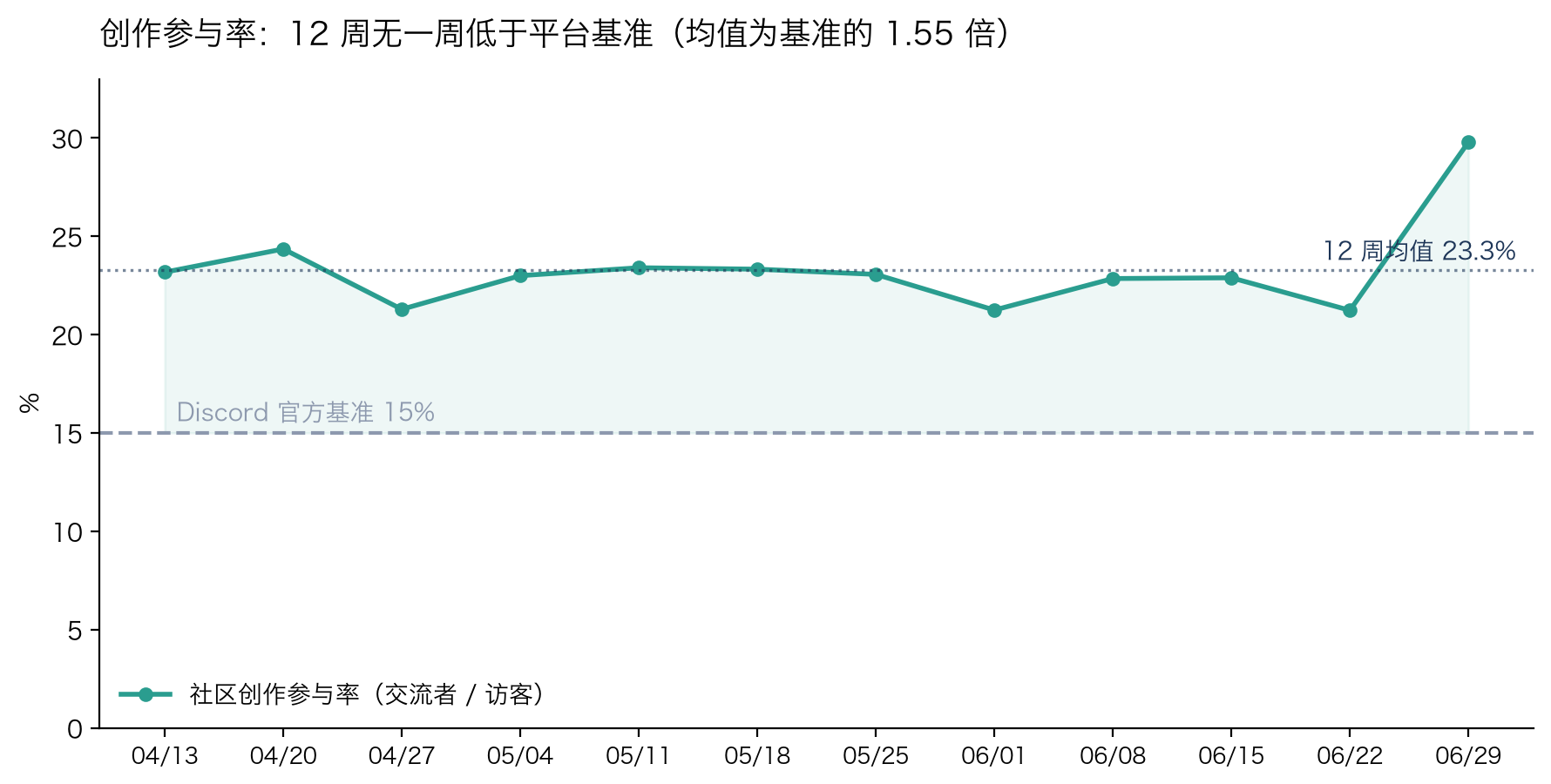
Creator participation was 22.94% before the purge and 23.51% after, essentially unchanged. The twenty-thousand-odd removed accounts were never in the active pool. My operating target had always been those 117 people, and the purge confirmed that judgment in the hardest possible way.
Shock two: the mechanism stopped in May
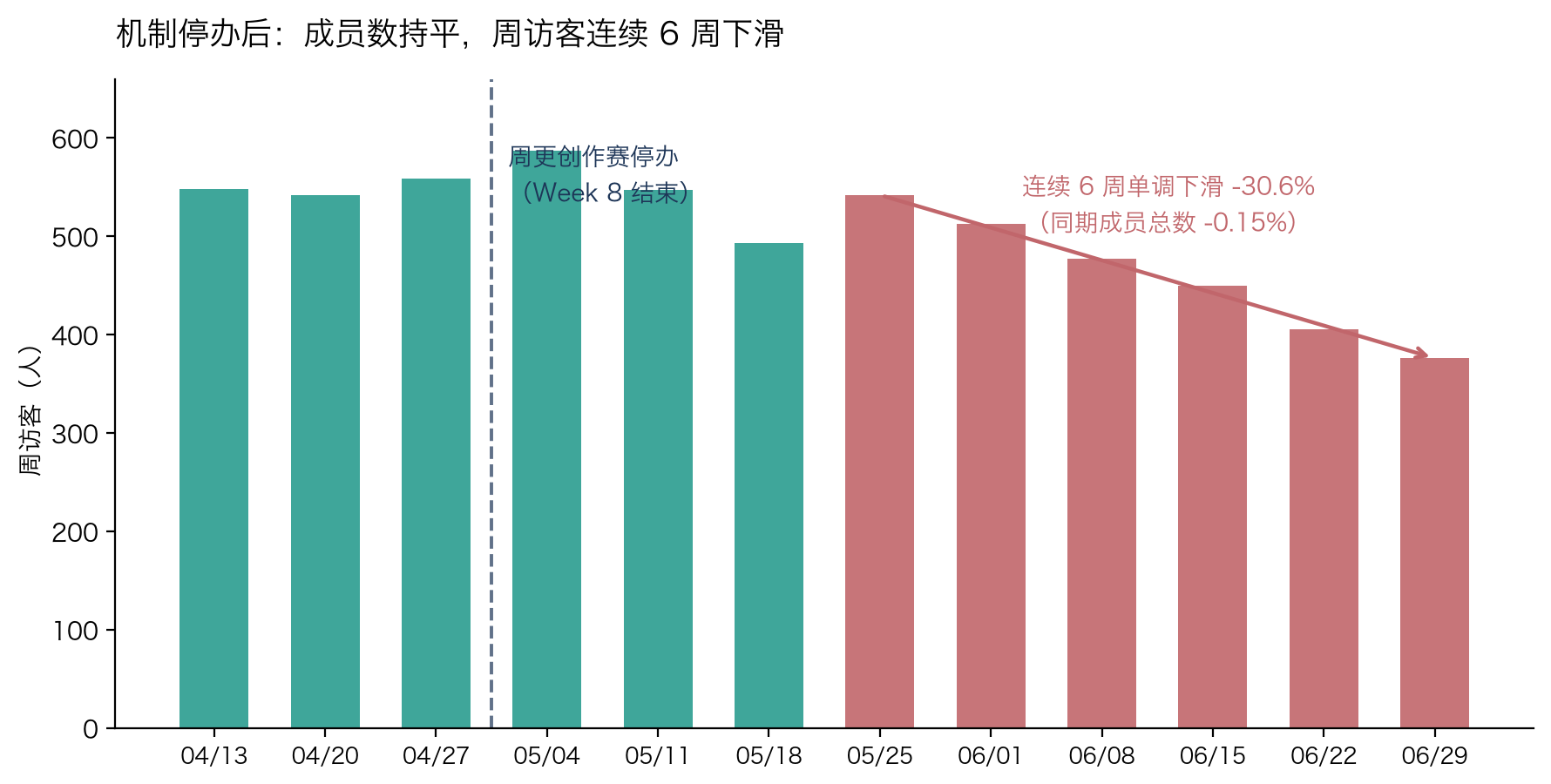
Member count barely moved after that (-0.15%), but weekly visitors declined monotonically for six straight weeks, -30.6% in total. The pool did not shrink, and the participation rate of those who stayed did not change. The only thing that disappeared was a reason to come back each week.
Separately, next-week retention for new members was 34.7%, or 1.73× the platform's 20% benchmark, though with a sample of 202 people, this is indicative rather than conclusive.
Four things I will carry into the next product
- Seasonal campaigns and standing mechanisms are different species. Campaigns produce scale (128 participants, 43 pieces); mechanisms produce habit (11 repeat creators). The first looks better on a slide; the second is the more valuable asset.
- Friction is a dial, not a bug. Zero friction buys scale; high friction filters for loyalty. What matters is not the height of the barrier but knowing what you are trading it for.
- Incentives inflate. Every reward issued is a liability, and the moment you design a reward you should be designing its recovery.
- When the product is imperfect, the mechanism can go first. Unstable generation did not stop 430 Personas from reaching the library, because the mechanism pointed user energy at the part of the product that was solid.
I would fix "nobody outside can see it" first
Looking back, the public-posting requirement should have shipped with the Lunar New Year campaign rather than arriving after the retrospective. At the time I treated "lower the barrier to entry" as self-evidently correct, when it also meant giving up external reach. I made that trade too late.